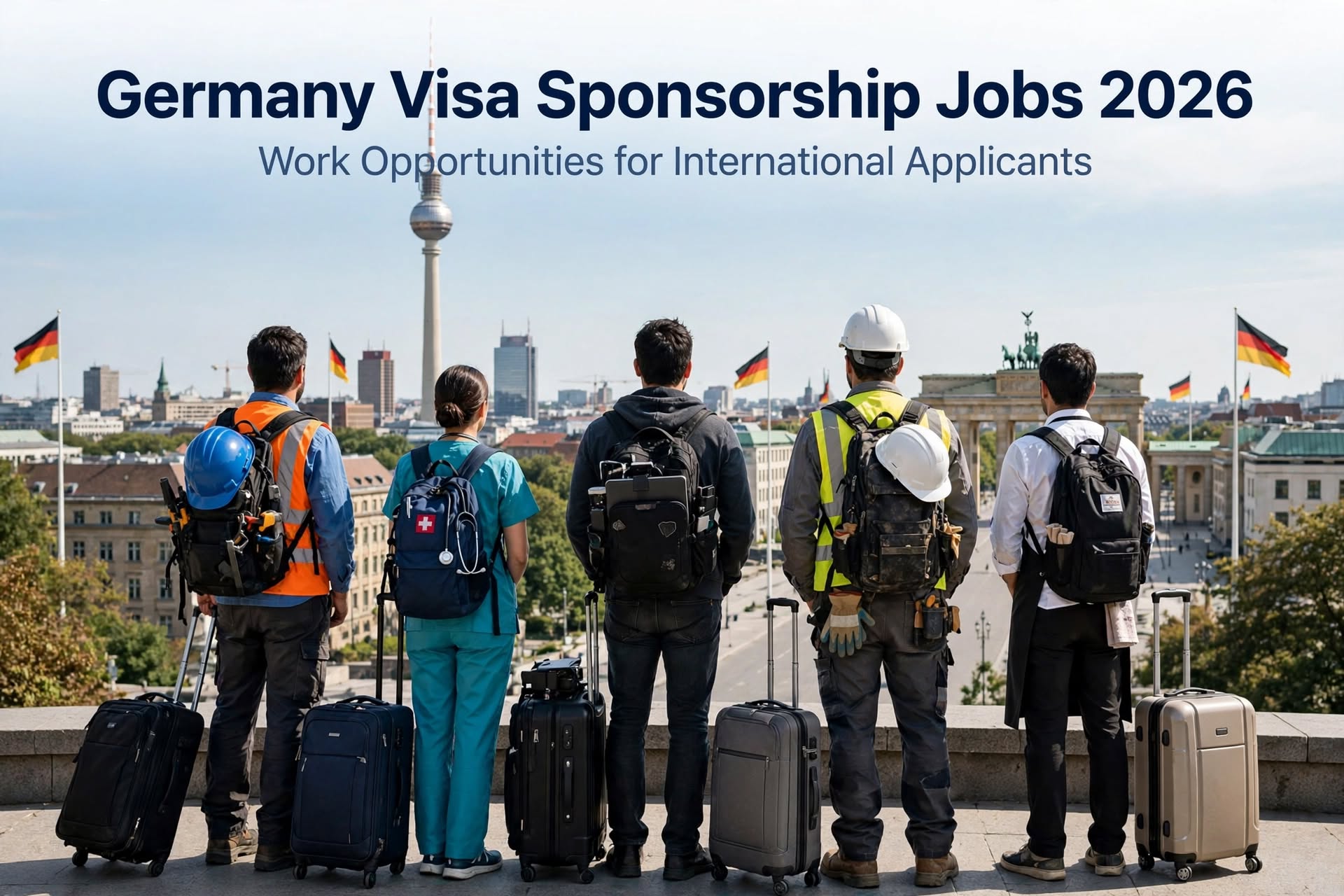
Germany continues to attract skilled workers from around the world because of its strong economy, excellent working conditions, and demand for qualified employees. In 2026, international applicants can find opportunities in several industries, including healthcare, information technology, engineering, construction, logistics, hospitality, and skilled trades.
For people outside the European Union, one of the most important questions is whether a German employer can support their work visa or residence application. This is where Germany visa sponsorship jobs 2026 become particularly important.
Although Germany does not use one universal “visa sponsorship” system in exactly the same way as countries such as the United States, German employers can hire qualified non-EU workers and provide the employment contract and other documents needed for the appropriate work visa or residence permit.
This guide explains how Germany visa sponsorship jobs work, which industries are hiring, what qualifications international applicants may need, and how to search for legitimate opportunities in 2026.
What Are Germany Visa Sponsorship Jobs?
Germany visa sponsorship jobs are employment opportunities offered to international workers who require legal authorization to work in Germany.
In many cases, the employer provides an employment contract or binding job offer. The worker then uses that documentation when applying for the appropriate German visa or residence permit.
The exact process depends on factors such as:
- Your nationality
- Your qualifications
- Your profession
- Your salary
- Whether your occupation is regulated
- Whether your educational qualification is recognized
- The type of German residence permit you qualify for
Therefore, applicants should not assume that every job advertised as “visa sponsorship” automatically guarantees a visa.
The employer may support the immigration process, but the final decision regarding a visa or residence permit is made by the relevant German authorities.
Why Work in Germany in 2026?
Germany is one of Europe’s largest economies and has a well-developed labor market. Many companies are looking for qualified workers, while demographic changes have increased the need for employees in several sectors.
International workers may be attracted by:
- Competitive salaries in skilled professions
- Strong labor protections
- Paid annual leave
- Public infrastructure
- Career development opportunities
- High demand for qualified professionals
- Opportunities to live and work in the European Union
- Established healthcare and social security systems
However, Germany is not equally accessible for every applicant. The strongest opportunities are generally available to people with qualifications, professional experience, technical skills, or occupations that are in demand.
High-Demand Jobs in Germany for International Workers
The availability of visa-supported employment changes from one employer and profession to another. However, several industries regularly attract international applicants.
1. IT and Software Jobs
Germany has a large technology sector and continues to need professionals with digital skills.
International applicants may find opportunities such as:
- Software developer
- Web developer
- Data analyst
- Cloud engineer
- Cybersecurity specialist
- IT project manager
- DevOps engineer
- Systems administrator
- AI and machine-learning specialist
Technology positions can be particularly attractive because some international companies operate in English, meaning German language skills may not always be essential.
However, learning German can still make it easier to communicate at work and manage everyday life.
2. Nursing and Healthcare Jobs
Healthcare is another important area for international recruitment.
Possible positions include:
- Registered nurses
- Nursing assistants
- Medical professionals
- Elder-care workers
- Healthcare specialists
- Medical technicians
Healthcare professions can have additional requirements because some occupations are regulated. Applicants may need recognition of their qualifications and, depending on the profession and circumstances, proof of German-language ability.
Anyone considering a healthcare position should carefully check the recognition and licensing requirements before accepting an offer.
3. Engineering Jobs
Germany has a strong industrial and manufacturing base, creating demand for qualified engineers.
Potential opportunities include:
- Mechanical engineers
- Electrical engineers
- Civil engineers
- Automotive engineers
- Industrial engineers
- Mechatronics engineers
- Automation specialists
- Production engineers
Candidates with internationally recognized degrees and relevant work experience may have stronger prospects.
4. Skilled Trades
Germany also needs workers in several skilled-trade occupations.
Depending on the employer and region, opportunities can include:
- Electricians
- Welders
- Plumbers
- HVAC technicians
- Mechanics
- Construction workers
- Machine operators
- Industrial technicians
Applicants should check whether their specific occupation requires formal recognition or other qualifications before applying.
5. Construction Jobs
Germany’s construction industry provides employment opportunities for qualified workers in areas such as building, infrastructure, installation, and technical construction.
Possible roles include:
- Construction workers
- Site supervisors
- Civil engineering technicians
- Heavy equipment operators
- Electricians
- Plumbers
- Skilled installers
Experience, vocational qualifications, and German-language ability can be valuable for many construction positions.
6. Logistics and Warehouse Jobs
Germany’s location in central Europe makes logistics an important part of its economy.
Companies may recruit for roles such as:
- Warehouse workers
- Logistics specialists
- Delivery drivers
- Forklift operators
- Supply-chain employees
- Warehouse supervisors
- Transport coordinators
Not every entry-level logistics position will qualify for a work visa. Applicants should therefore focus on positions where their qualifications and the job requirements meet German immigration rules.
7. Hospitality and Tourism
Hotels, restaurants, catering companies, and tourism businesses can also employ international workers.
Potential positions include:
- Chefs
- Cooks
- Hotel staff
- Restaurant employees
- Kitchen workers
- Housekeeping staff
- Hospitality supervisors
The availability of visa-supported positions depends heavily on the job, salary, qualifications, and applicable immigration rules.
Germany Work Visa and EU Blue Card
International applicants may qualify for different immigration routes depending on their circumstances.
One well-known option for highly qualified professionals is the EU Blue Card. It is designed for qualified workers who meet specific requirements related to employment, qualifications, and salary.
Other workers may qualify for different employment-based residence permits.
Germany has also introduced and expanded immigration pathways intended to make it easier for qualified international workers to enter the German labor market.
Because immigration rules can change, applicants should always check the current requirements through official German government sources before paying an agency or accepting an employment offer.
Do You Need a Job Offer Before Applying?
For many employment-based immigration routes, having a suitable job offer or employment contract is an important part of the application.
The job offer should clearly identify information such as:
- Employer name
- Job position
- Salary
- Working hours
- Employment location
- Start date
- Contract conditions
Applicants should be cautious if someone promises a German work visa without a genuine employer or employment contract.
A legitimate employer should be identifiable and the job should have clear responsibilities and conditions.
How to Find Germany Visa Sponsorship Jobs in 2026
Finding a genuine opportunity requires more than searching for the phrase “Germany visa sponsorship.”
Start by identifying your strongest professional skills and the German jobs that match your experience.
Step 1: Prepare a German-Style CV
Create a professional CV that clearly presents:
- Education
- Work experience
- Technical skills
- Certifications
- Language skills
- Contact information
- Relevant achievements
Keep the information accurate and avoid adding qualifications you cannot verify.
Step 2: Search for Suitable Employers
Look for companies that regularly hire international employees.
Useful places to search include:
- German government employment resources
- Major job portals
- Company career pages
- Professional networking platforms
- Industry-specific recruitment websites
Search using terms such as:
“Germany visa sponsorship jobs 2026”
“Jobs in Germany for foreigners”
“Germany jobs with relocation”
“Germany skilled worker jobs”
“Germany jobs for international applicants”
You can also search for your profession directly, such as “software developer Germany,” followed by terms like “international applicants” or “relocation.”
Step 3: Check the Job Requirements
Before applying, carefully read the vacancy.
Pay attention to:
- Required qualifications
- Experience
- German-language requirements
- English-language requirements
- Salary
- Location
- Employment type
- Recognition requirements
- Work authorization information
Applying for jobs that closely match your profile generally produces better results than sending the same CV to hundreds of unrelated vacancies.
Step 4: Apply Directly
Whenever possible, apply through the employer’s official career website or a reputable recruitment platform.
Avoid sending money to an individual simply because they claim to have a German job available.
A genuine job application should have a clear employer, position, and recruitment process.
Can You Get a Germany Visa Without Knowing German?
Yes, in some circumstances.
German-language requirements depend on the occupation and immigration route. Some international companies recruit employees who work primarily in English, particularly in technology, research, engineering, and other international business environments.
However, German language skills can significantly improve your employment prospects.
For jobs involving direct communication with German-speaking customers, patients, colleagues, or government institutions, German may be particularly important.
Learning German to at least a basic level can therefore be a useful investment even when a particular vacancy does not require it.
Germany Visa Sponsorship Jobs for Pakistani Applicants
Pakistani professionals may also apply for suitable employment opportunities in Germany.
Applicants from Pakistan should focus on occupations that match their education, skills, and professional experience.
For example, qualified applicants may explore:
- IT and software development
- Engineering
- Healthcare
- Skilled trades
- Construction
- Logistics
- Technical professions
Before applying, Pakistani applicants should verify the recognition status of their qualifications and understand the current German visa requirements that apply to their individual circumstances.
It is also important to apply through legitimate employers and official channels rather than relying on unverified social-media advertisements.
How Much Can You Earn in Germany?
German salaries vary considerably according to profession, experience, location, qualifications, and employer.
Highly qualified professionals in technology, engineering, healthcare, and management may earn significantly more than workers in entry-level occupations.
Your salary is also affected by taxes and social contributions.
When comparing job offers, do not look only at the advertised gross salary. Consider:
- Gross monthly salary
- Estimated net income
- Rent
- Transportation
- Health insurance
- Taxes
- Other living expenses
A job with a higher salary in an expensive city may not necessarily provide more disposable income than a lower-paid position in a cheaper area.
Beware of Germany Job and Visa Scams
The popularity of overseas employment has unfortunately created opportunities for scammers.
Be particularly careful if someone promises:
- Guaranteed German visa approval
- Guaranteed employment without an interview
- Extremely high salary for unskilled work
- A visa in exchange for a large upfront payment
- A job without a proper contract
- A work permit that can supposedly be purchased
Never assume that an advertisement is legitimate simply because it contains the words “Germany visa sponsorship.”
Verify the employer, job vacancy, contract, and immigration requirements independently.
If a recruiter asks for money, carefully investigate what the payment is for and whether the company is legitimate.
Documents International Applicants May Need
The exact documents depend on your visa and personal circumstances, but applicants may commonly need documents such as:
- Valid passport
- Employment contract or job offer
- Educational certificates
- Professional qualifications
- Proof of work experience
- CV
- Qualification recognition documents, where applicable
- Language certificate, where required
- Visa application forms
- Passport photographs
- Proof of accommodation or other supporting documents, depending on the application
Some documents may need translation or certification.
Always follow the document checklist provided by the relevant German authorities for your specific application.
Tips to Improve Your Chances of Getting Hired
International applicants can improve their chances by taking a targeted approach.
Match your CV to the job: Highlight the experience and skills specifically requested by the employer.
Improve your language skills: English can be enough for some international jobs, but German can open additional opportunities.
Get qualifications recognized: If your occupation requires recognition, start the process early.
Build relevant experience: Employers are more likely to consider candidates who can demonstrate practical skills.
Use professional job platforms: Search through reputable employment websites and official company career pages.
Research the employer: Confirm that the company exists and that the vacancy is genuine.
Prepare for interviews: Be ready to explain your qualifications, experience, salary expectations, and reasons for wanting to work in Germany.
Frequently Asked Questions
Are there Germany visa sponsorship jobs in 2026?
Yes. German employers can hire qualified workers from outside the EU when the employee meets the requirements of the relevant immigration route. Opportunities vary by profession, employer, and qualification.
Can foreigners get jobs in Germany?
Yes. Germany employs many international workers. However, non-EU applicants generally need appropriate authorization to live and work in Germany.
Which jobs are easiest for foreigners to find in Germany?
There is no single easiest job. Demand can be strong in areas such as IT, healthcare, engineering, skilled trades, and certain technical professions, but eligibility depends on your qualifications and the specific position.
Do I need German to work in Germany?
Not always. Some employers, particularly international companies, offer positions where English is the primary working language. German is nevertheless highly valuable for many occupations and everyday life.
Can I get a German work visa with a job offer?
A suitable job offer can be an important part of many employment-based immigration routes, but having an offer does not automatically guarantee visa approval. You must meet all applicable requirements.
Can Pakistani citizens apply for Germany visa sponsorship jobs?
Yes. Pakistani citizens can apply for suitable German employment opportunities. If selected, they must follow the applicable German immigration and visa process for their circumstances.
Final Thoughts
Germany visa sponsorship jobs 2026 can provide an opportunity for qualified international workers to build careers in one of Europe’s largest economies. Demand can be found across areas such as IT, healthcare, engineering, skilled trades, construction, logistics, and other technical professions.
The most important step is to find a genuine job that matches your qualifications and then determine which German immigration route applies to your situation.
Do not rely on advertisements promising guaranteed visas or jobs in exchange for large payments. Instead, research employers carefully, prepare a strong CV, verify qualification requirements, and use official immigration information before making important decisions.
For international applicants willing to develop their skills, improve their language abilities, and follow the proper application process, Germany can offer valuable professional opportunities in 2026 and beyond.